- Conversion rate optimization (CRO) means getting a higher share of the visitors you already have to take the action you want.
- A campaign converting at 2% needs double the budget to match a campaign converting at 4%. A winning CRO change keeps paying off every month without extra spend.
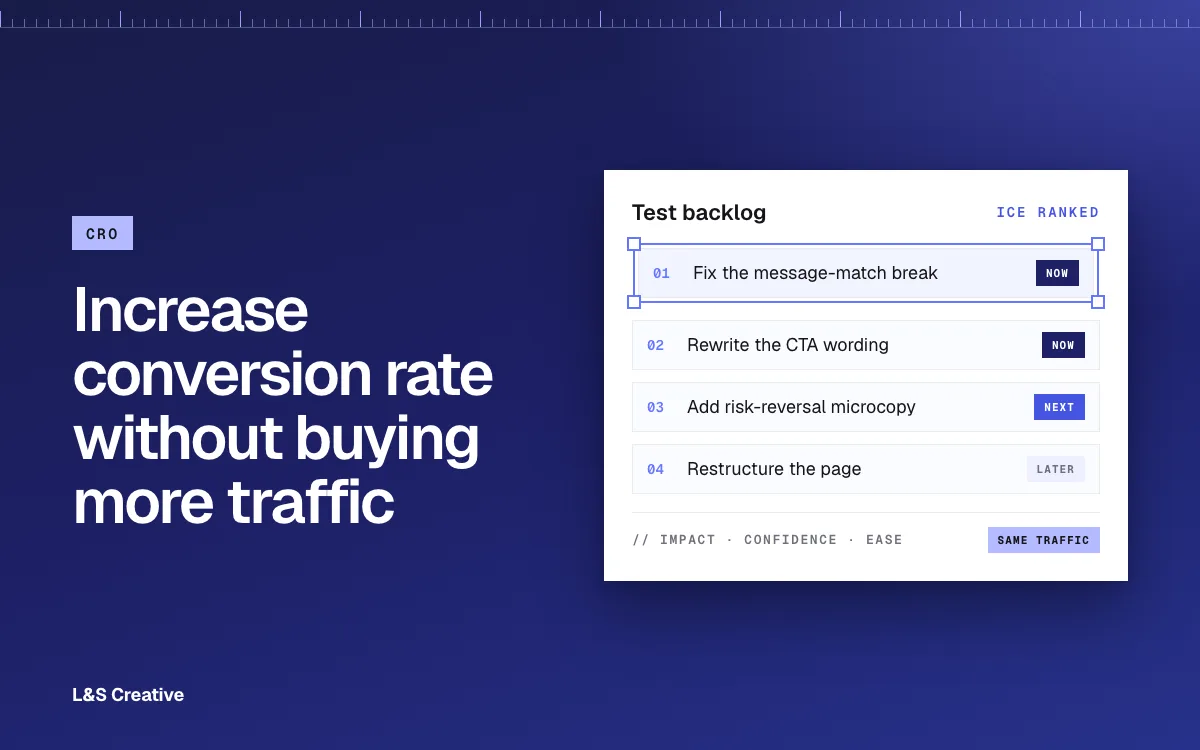
- A conversion killer we see often is a message-match break: your call-to-action promises one thing, and the page it leads to delivers another.
- Every lift number here comes from a named, sourced case study. Your results depend on your own traffic and baseline.
- Skip A/B testing on low-traffic pages. Our rule of thumb: below roughly 1,000 sessions and 25 conversions per variant per month, a split test is unlikely to reach significance in a reasonable window. Use a before/after change instead, and say so.
- Start with the cheapest, highest-confidence fixes (copy, CTA wording, risk-reversal microcopy) before touching anything structural.
How do you increase your website’s conversion rate without spending more on ads?
You find where visitors are already dropping off, form a specific testable idea about why, change one thing, and measure whether it moved the number that matters. That’s the whole method. For many sites, the faster win is getting more of today’s visitors to finish what they started.
Here’s the math that makes this worth doing before you touch the ad budget: if a page converts 1,000 monthly visitors at 2%, that’s 20 demos. Move the same page to 4% and you get 40 demos from the exact same 1,000 visitors. To get that second 20 demos from paid traffic instead, you’d have to double your spend. CRO is a multiplier on money you’re already spending on traffic. A winning change also keeps paying off every month, long after the campaign that brought the visitors ends.
Step 1: find out where the money is actually leaking
Skip opinions about what “looks better.” Pull the data first, from five places:
- Analytics. Where do visitors land, where do they drop off, which pages get real traffic but zero conversions, and is there a gap between mobile and desktop performance.
- Search Console. Pages with high impressions but low clicks usually point to a title-and-meta problem. Fix those first; they’re often the fastest wins.
- Behavior tools. Heatmaps, scroll depth, session recordings, and form-field drop-off. Microsoft Clarity covers most of this for free.
- Voice of customer. Sales-call objections and support tickets are often the richest, least-used source. Ask your sales team what almost stops a deal every single week.
- A heuristic walkthrough. Click through your own funnel on a slow phone connection. Note every point where you hesitate, get confused, or wonder what happens next.
Step 2: turn every finding into a specific, testable hypothesis
A vague idea can’t be tested. “A cleaner hero would convert better” tells you nothing, because “better” has no number and “cleaner” isn’t a change anyone can build. Every real hypothesis fills in four blanks:
We believe that [a specific change to a specific element]. It will cause [a specific effect on the one conversion metric that counts], because [the research or data that makes us think so]. We will know we’re right when [the metric moves by a stated amount, at a stated confidence level, over a stated window].
Here’s what that looks like against a real teardown. In July 2026 we ran our CRO method against a B2B SaaS company’s public homepage, pricing page, and demo flow. It was a demonstration exercise and the company isn’t a client, so every number below is either a directly observed fact from the live pages or a clearly labeled modeled estimate. The clearest problem we found: the homepage’s primary call-to-action read “Schedule a Demo,” but clicking through delivered a gated seven-minute video. Someone expecting to book time with a human hit a video wall instead.
The hypothesis we’d write against that: we believe that changing the demo CTA to describe what the page actually delivers (“Watch a 7-minute demo” instead of “Schedule a Demo”) will increase demo-path completions, because the current copy promises a live meeting the page doesn’t deliver, which is a likely cause of expectation-mismatch drop-off. We will know we’re right when demo completions per CTA click rise at 95% significance over a full test cycle.
That’s a message-match break, and we see it often: the page after the click doesn’t deliver what the button before the click promised.
Step 3: prioritize with ICE scoring
Score every idea 1 to 10 on three axes, average them, and run the highest scores first.
- Impact. If this test wins, how much does it move the one conversion metric that counts? A hero CTA on your highest-traffic page scores high. Microcopy on a page nobody visits doesn’t.
- Confidence. How sure are we this wins? A hunch scores low. A documented outside case study that agrees with what we observed on your specific pages scores high.
- Ease. How fast and cheap is it to actually ship? A copy swap in your CMS scores high. A new page that needs engineering and legal review scores low.
Two guardrails matter more than the score itself. First, the traffic gate. Our rule of thumb is that a page needs roughly 1,000 sessions and 25-plus conversions per variant, per month, to reach statistical significance in a reasonable window. Below that floor, a split test is unlikely to conclude, so run a measured before/after change instead and say so plainly. A low-traffic A/B test rarely proves anything. Second, confidence honesty: a borrowed case-study stat only raises your confidence a little on its own. It’s only genuinely high confidence when the outside result and your own on-page data point the same direction.
Changes with documented wins in public case studies
Here are four tests with public, sourced results. Every number below has a named source. None of them is a promise about what will happen on your site, because your baseline, traffic, and audience are different.
- Name the actual action in the CTA. Going changed its button copy from “Sign up for free” to “Trial for free” and saw its trial start rate rise 104% month over month, according to Unbounce’s Going case study.
- Make the form easy to find. ArchiveSocial moved the email form in its homepage banner into the first fold and gave it a contrasting color. Clicks on the form field rose 101.68%, according to VWO’s ArchiveSocial case study.
- Put the essentials above the fold and ask for the key field first. On ICICI Lombard’s mobile insurance form, the agency Tatvic put the plan name, selling points, and benefits above the fold, made the quote button sticky, and moved the mobile number field to the start of the form. Form completions and “Get a Quote” interactions rose 30.09%, and mobile number submissions rose 44.25%, according to VWO’s Tatvic case study.
- Shorten the page and add proof. Across four tests, POSist (now Restroworks) cut low-value sections from its homepage, added customer logos and testimonials, narrowed its contact form, and removed exit links from its contact page. VWO reports 52% more leads in a single month, in its POSist case study.
We don’t sum these numbers or promise your site will see anything close to them. Treat them as evidence a lever is worth testing.
Step 4: run it long enough to trust the answer
The most common way CRO goes wrong we see is calling a winner off noise. Decide your sample size and duration before you launch, using a calculator that accounts for your baseline rate, the minimum lift worth caring about, 95% confidence, and 80% power. Run at least one full week, ideally two or more, so weekday and weekend effects wash out. Never stop a test mid-week because it “looks significant.” Report the lift as a range, and watch the downstream metric too: a form that gets more submissions but worse-quality leads is still a loss.
And if the test comes back flat? That’s still a result. It tells you the lever doesn’t matter here, which is useful information. Log it, move to the next hypothesis, and don’t force a story onto a null result.
An illustration: what a modeled outcome looks like
On the same teardown, we modeled what a 90-day CRO program could add. We used placeholder traffic and baseline numbers, because we don’t have that site’s real analytics. At an assumed 120,000 monthly sessions reaching a primary call-to-action and a 3.0% blended baseline conversion rate, that’s 3,600 monthly conversions to start. A conservative modeled net lift of 8% across a 90-day program adds roughly 288 conversions a month; a base case of 15% adds roughly 540; a stretch case of 25% adds roughly 900. Every one of those numbers is an assumption, built only to show the method. They say nothing about that company’s actual results. The moment we have a client’s real baseline, every placeholder gets replaced before we quote anything.
The limits, honestly
CRO doesn’t fix a demand problem. If nobody’s landing on the page in the first place, no amount of copy testing changes that; that’s a traffic and channel problem, and a different conversation. Lifts from separate tests don’t stack the way people hope: two +20% wins tested separately rarely produce +44% together, because the changes interact. We measure the combined lift. And a test needs real traffic to mean anything. If your site doesn’t have the volume for a proper split test yet, the honest move is a before/after change with a longer measurement window.
FAQ
How do I increase my website’s conversion rate without spending more on ads?
Find where visitors on your existing traffic are dropping off using analytics, Search Console, and behavior data, turn the biggest gap into a specific hypothesis, and test one change at a time against your real numbers. It works on traffic you already have, so it needs no new ad spend.
What conversion rate is considered good for a B2B SaaS website?
There’s no single universal benchmark worth quoting, because it depends heavily on traffic quality, funnel stage, and what a conversion means for your business. The more useful number is your own baseline, tracked consistently, so you can measure real movement against it.
How long does a CRO test need to run?
At least one full week, ideally two or more, so weekday and weekend patterns even out. Decide your sample size and duration before launch based on your baseline rate and traffic volume, and don’t stop early just because a result looks good.
What conversion problem do you see often on B2B SaaS sites?
A message-match break: the call-to-action promises one thing and the page it leads to delivers something else, most often around demo requests. Fixing the mismatch, either by changing the copy to match the page or the page to match the promise, is often a strong first test.
Do I need enough traffic to run an A/B test?
Yes. Our rough floor is around 1,000 sessions and 25-plus conversions per variant per month to reach statistical significance in a reasonable window. Below that, run a measured before/after change instead of a split test that is unlikely to conclude.
What is ICE scoring in conversion rate optimization?
ICE stands for Impact, Confidence, and Ease. Score every test idea 1 to 10 on each axis, average the three scores, and run the highest-scoring ideas first. It ties prioritization to evidence, so the order of tests is set by scores you can explain.
Ready when you are
Want a teardown of your own funnel, the same way we ran one here? Book a Strategy Call and we’ll look at where your traffic is leaking. Read more on how we run SEO, AEO, and CRO as one system, browse our case studies, or see how to reduce bounce rate for the traffic-quality side of this same problem.