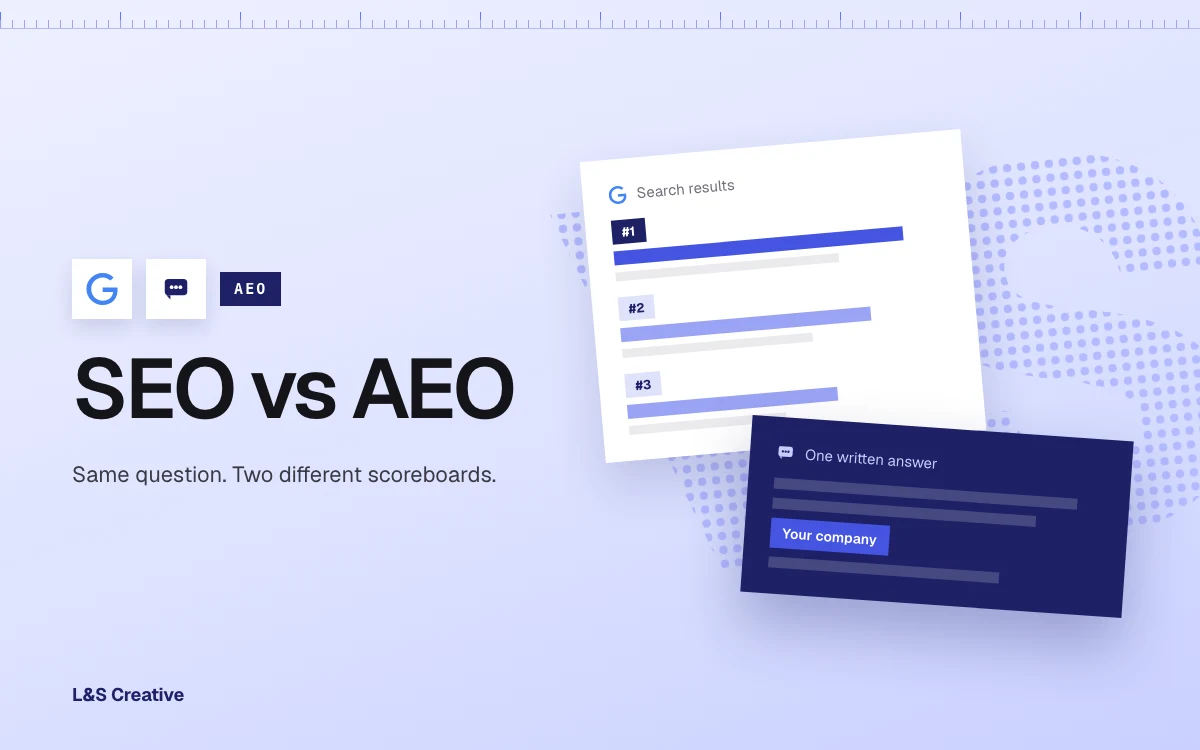
- SEO earns a ranked link. AEO earns a mention inside the written answer. ChatGPT, Perplexity, Gemini, and Google AI Overviews write one answer, with or without your name in it.
- SEO is the floor AEO stands on. Google says a page must already be indexed and eligible to rank with a snippet before it can be cited as a supporting link in an AI Overview, and adds there are no extra requirements beyond that.
- ChatGPT runs its own, separate crawler rules. OAI-SearchBot decides whether you can appear in ChatGPT's live search answers. GPTBot only controls AI training data. Sites that block "AI bots" broadly often lock out the one that controls citations without realizing it.
- Interest in telling the two apart is real and still growing. In our own October 2026 DataForSEO pull, "aeo vs seo" gets an estimated 1,900 U.S. searches a month and "what is aeo" gets 4,400, both at low-to-medium keyword difficulty.
- You measure them differently. SEO: rankings, impressions, and clicks in Search Console. AEO: a citation rate, built from the same buyer prompts run across engines on a schedule, since nobody can guarantee one citation.
- Run them as one program. They share a technical foundation. Splitting SEO and AEO across two vendors usually means the AEO fixes never make it off a backlog.
SEO earns you a ranked link in Google’s results. AEO earns you a mention inside the one written answer ChatGPT, Perplexity, or an AI Overview gives back. Same buyer, same question, two different scoreboards.
Watch it happen: type a question into Google and you get ten blue links. Ask ChatGPT or an AI Overview the same question and you get one written answer, your name in it or not.
What is AEO?
AEO, answer engine optimization, is the work of getting a company named and cited inside the answers an AI tool gives, rather than ranked as a link beneath it. You will also hear the same discipline called GEO (generative engine optimization) or LLM SEO. All three names point at the same goal: when a buyer asks ChatGPT, Perplexity, Gemini, Claude, or a Google AI Overview who to use, your company shows up inside the answer itself.
For a B2B SaaS marketing team, that question usually sounds like “best [category] software for [use case],” and it now gets typed into a chat window about as often as it gets typed into a search bar.
SEO vs AEO: the core difference
The two disciplines chase the same buyer, at two different moments, and they get judged on different things.
| SEO | AEO | |
|---|---|---|
| What you are optimizing for | A ranked position in Google’s list of links | A mention inside the written answer an AI engine gives |
| Where the work lives | Titles, meta, headings, backlinks, Core Web Vitals | The same technical foundation, plus AI crawler access, schema, and answer-first passages |
| How you measure it | Rankings, impressions, and clicks in Search Console | A citation rate: how often you are named, counted prompt by prompt, across engines |
| What “winning” looks like | Page one for the searches that matter | Named inside the answer, with a real share of voice against competitors |
| How fast it moves | Rankings can hold steady for months once earned | The same prompt can return a different answer the next time someone runs it |
Where SEO and AEO share the same foundation
Neither discipline starts from scratch next to the other. For Google’s own AI features, the connection is direct. Google’s documentation states that to be eligible to show as a supporting link in AI Overviews or AI Mode, “a page must be indexed and eligible to be shown in Google Search with a snippet, fulfilling the Search technical requirements,” and adds that “there are no additional requirements to appear in AI Overviews or AI Mode, nor other special optimizations necessary” (Google Search Central). In plain terms: if Google cannot already rank your page, Google’s own AI Overview is not going to cite it either.
ChatGPT runs on a different rulebook, and it is the one most teams get wrong. OpenAI separates its crawlers by job. GPTBot only gathers content for training future models. A separate bot, OAI-SearchBot, decides whether a page can appear in ChatGPT’s live search answers at all. OpenAI’s own crawler documentation says it plainly: “Sites that are opted out of OAI-SearchBot will not be shown in ChatGPT search answers, though can still appear as navigational links” (OpenAI). Plenty of sites block “AI bots” broadly in robots.txt, see GPTBot in the list, and disallow it to opt out of AI training, never realizing OAI-SearchBot is a separate line they never checked.
Why this comparison is getting its own search volume now
Search interest in telling the two apart is new enough that it is still climbing. In our own October 14, 2026 pull from DataForSEO (Google, US, English), “aeo vs seo” gets an estimated 1,900 searches a month at a keyword difficulty of 17, “what is aeo” gets 4,400 at a difficulty of 37, and “seo vs aeo” gets 1,000 at a difficulty of 9. All three sit at low-to-medium competition, which tells you marketing teams are actively trying to understand this distinction right now.
Do you need a separate AEO strategy, or just better SEO?
The honest answer: you need both, run from one plan. At L&S we run SEO and AEO as one program for exactly this reason. They share a technical foundation, and splitting them across two vendors usually means the AEO fixes never get built, because nobody owns the backlog.
What changes between the two is what you measure, and some of what you ship. Crawler access rules for AI bots, schema cleanup aimed at machine readers, and answer-first content are AEO-specific work, layered on top of the same crawlable, well-structured site that SEO already needs. If your site cannot already rank for a term, adding AEO work on top of it will not fix the underlying gap.
How to measure both without fooling yourself
SEO gives you rankings, impressions, and clicks in Google Search Console. AEO needs a different number: a citation rate, built by running the same set of buyer questions through multiple AI engines on a schedule and counting how often your company is actually named.
Nobody, including us, can guarantee a citation in any AI engine. The same prompt can return a different answer the next time it runs. What you can control is a fixed set of prompts, tracked consistently across engines, so you know your real trend instead of a single lucky or unlucky screenshot.
If you want the deeper technical SEO checklist first, start with our Webflow SEO guide or our list of SEO tools worth checking.
FAQ
What is AEO?
AEO (answer engine optimization) is the work of getting a company named and cited inside the answers AI tools give, such as ChatGPT, Perplexity, Gemini, Claude, and Google AI Overviews. It is also called GEO (generative engine optimization) or LLM SEO. All three names describe the same goal: showing up inside the answer itself.
What is the difference between SEO and AEO?
SEO earns a ranking in Google’s list of links. AEO earns a mention inside the written answer an AI tool gives back. They share the same technical foundation, a crawlable, well-structured, clearly written site, so most B2B teams run them as one program rather than two.
Does good SEO automatically improve AEO, or are they separate skills?
Good SEO is the floor. It carries real weight, but it does not guarantee a citation on its own. Google says a page must already be eligible to rank with a snippet before it can be cited in an AI Overview. AEO adds work SEO does not cover on its own: checking which AI crawlers can reach your site, schema aimed at machine readers, and content written to be quoted directly.
How do you measure AEO performance?
You build a fixed list of the questions your buyers actually ask, run them through several AI engines with web search on, and count how often your company is named versus your competitors. Re-run the same prompts on a schedule, monthly is typical, so you are tracking a real trend.
Do we need a separate AEO budget and vendor, or can our SEO team handle it?
If your SEO team already owns crawlability, schema, and content, the gap is someone adding the AI-specific checks: crawler access for bots like OAI-SearchBot and PerplexityBot, schema an AI parser can read, and a citation-rate measurement, on top of the SEO work already underway.
Can you guarantee a citation in ChatGPT or an AI Overview?
No, and no agency honestly can. Nobody controls what an AI engine decides to say, and the same prompt can produce a different answer on the next run. What is controllable is measurement: a fixed set of buyer prompts, tracked consistently across engines, so you know whether your real citation rate is moving.
Ready to see where you stand on both?
A single buyer question can get you ranked on Google and left out of ChatGPT in the same hour, or the reverse. Book a Strategy Call and bring the three questions your buyers ask most. We will show you where you rank and where you are cited today. Read more about our SEO services and our AEO services.